
What is the role of innovation in agriculture? Is technology compatible with the principles of agroecology?
Route to Food Initiative was joined by friends and partners, including Greenpeace Africa, Right to Food Coalition, WingFarm, Burner Market, Consumer Grassroots Association (CGA), Institute for Food Justice and Development (IFJAD), and World Food Forum Kenya, among others, to celebrate World Food Day on 16 October 2026 at the Grow Biointensive Agriculture Centre of Kenya (G-BiACK) in Thika. With the global theme “Innovate Today, Nourish Tomorrow,” we sought to rethink technology for sustainable food systems and explore what innovation means for smallholder farmers.
At the World Food Day celebration, Christine Gatwiri of Route to Food Initiative led the discussion on technology versus innovation, inviting participants to explore what innovations for smallholder farmers look like. Examples of biological innovations include push-pull methods, agroforestry, crop diversification and companion planting, while pheromone traps are used for pest control. Water harvesting and storage systems are also important, and participants raised questions about technologies for recycling grey water for reuse on the farm. Black soldier flies and vermiculture are additional technologies used to produce animal feed as well as organic manure for use on the farm. Working with the natural environment in these ways is innovative, which is why agroecology is considered one of the most innovative approaches to agriculture. These practices also help reduce reliance on external inputs.
Lynn Ngetich from Greenpeace Africa led the discussion on digital technologies, including computer-based tools. The discussion focused on the benefits and potential harms of these technologies, and how innovation should come from and serve the needs of farming communities rather than be forced on them. In view of farmer sovereignty, the discussion also emphasised data sovereignty, including farmers having a say in how their data is collected, used and shared. This is particularly important as digital platforms and artificial intelligence (AI) tools proliferate. Much of the data generated through these tools can be extracted and controlled by private technology companies or buyers, leaving smallholder farmers with limited control over its use and little share in the economic value it generates. As highlighted in the IPES-Food report Head in the Cloud, digitalisation can also concentrate power in the hands of technology companies and increase farmers' dependency on external systems.
The third session focused on gender and innovation and was led by Oscar Odour from the Community Empowerment for Sustainable Development (CESDI). The discussion emphasised the importance of local methods that give farmers more control over their production without adding to gender-based labour demands. Odour noted that women perform a significant share of global agricultural labour but continue to face a gender gap in access to technology. During the discussion, members of the Happy Families Champions, supported by The Institute for Social Accountability (TISA) emphasised that gender-responsive innovations should take women's specific workloads and priorities into account. This means ensuring that agricultural technologies respond to women's needs without increasing their workload or reinforcing existing inequalities.
The final session was a farm tour led by Pauline Owiti of World Food Forum Kenya chapter, during which participants identified and marked the various innovations at G-BiACK. These included vermiculture, composting, liquid manure, seed banking, and roof runoff harvesting with underground storage. Participants also explored the ten-bed unit, a diversified crop production model that allocates 30% of production to high-calorie root crops, 50% to calorie-producing crops and 20% to vegetables for vitamins and minerals. Such farm planning techniques promote crop diversity and make effective use of small land parcels.
The discussions and farm tour highlighted that innovation is not necessarily about gadgets and software. For many of the small-scale farmers at the World Food Day event, innovation is about production process improvements, practical changes that build soil health, reduce expensive external inputs and help farmers cope with climate shocks, while remaining affordable and under farmer control. Today, what many consider progressive, modern or innovative is often associated with digitalisation, apps and computer technologies, including AI. However, the discussions with participants and the subsequent farm visit demonstrated that innovation is much broader and is not necessarily contrary to agroecological principles.
Innovations are therefore worth investing in, from the farm level to government policy. They can help reduce reliance on external inputs, ease the drudgery associated with some farm activities, and improve storage and market access. These improvements can strengthen production, reduce waste and support better outcomes for farmers and consumers. Innovation can happen at the farm or come from outside it. External innovations, including digitalisation initiatives, can be beneficial, but caution must be applied to ensure that they uphold the core principles of agroecology, including the respect and fulfilment of human rights and the safeguarding of farmers' autonomy and sovereignty.
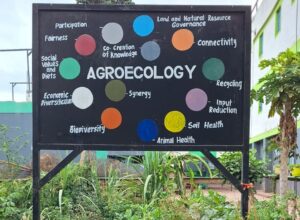
This is where the concept of agroecologising digitalisation becomes important. As explained by the Food and Agriculture Organization of the United Nations (FAO) in Let's agroecologize digitalisation!, this means applying agroecological principles to both the development and use of digital tools. Digital tools for agroecology should support farmers in improving their food-related activities in line with the 13 principles and 10 Elements of Agroecology.
Ultimately, the question is not whether technology belongs in agroecology, but whether they support the transformation of food systems including challenging power imbalances between owners and users of digital technologies. For innovations to nourish tomorrow, they must contribute to sustainable food systems while building farmers' autonomy and their right to food.
Sources
- IPES-Food. (2026). Head in the Cloud: Challenging the False Promise of Digital Agriculture and Cultivating Innovation from the Ground Up. https://ipes-food.org/report/head-in-the-cloud/
- Food and Agriculture Organization of the United Nations (FAO). (2024). Let’s agroecologize digitalisation! https://www.fao.org/agroecology/in-action/detail/let-s-agroecologize-digitalisation!/en


